On 31 October 2026 three researchers at Google DeepMind, Alex Imas, Andrew Koh and Shane Legg, posted a working paper called Organizing Intelligence. It asks a question most of the AI conversation skips: when does any of this actually transform the economy?
Their answer is not the one the benchmark charts imply. In their model, what decides it is not how capable a single system is. It is how well capable things work together.
I think the paper matters to anyone who designs organisations for a living, for two reasons. It names the variable our discipline keeps leaving off the diagram. And it puts a hard question to something I wrote on this site last year.
Two kinds of capability
The paper gives every worker, human or machine, two kinds of capability. Competence is how well you do the task. Coordination is how well you work with others. A firm with more competent members produces more at any size. A firm with better coordinators can grow larger before it starts to choke on itself: in the authors’ words, it “enjoys better returns to scaling”.
Their worked example makes this concrete. Start with coders and writers, each strong at one thing and weak at the other. Then add a third type, the coordinator, who is weak at both. “Judged by any standalone single-agent benchmark, a coordinator is the weakest worker in the economy.” Yet with her in it the best team grows from six people to seven, the teams produce more in total, and she earns nearly ten times what she could get by staying out.
The person who ranks last on every individual test is the one who lets the organisation grow.
From there the model runs forward. Make AI more competent and output gets cheaper and the mix of people inside firms changes, but firms do not get bigger, and may get smaller. Make AI better at coordination and, past a threshold, large markets tip toward a few very large, AI-heavy firms. The authors add that regulation, competition between AI providers and capacity limits would probably stop that short in practice, and they are careful throughout to say their scenarios are “not empirical forecasts but outcomes based on the model’s assumptions”. I am reading them the same way.
On where we are today, they read the evidence as strong on tasks and weak on coordination. One study they cite found multi-agent systems failing on between 41 and 87 per cent of tasks, depending on the system and the benchmark, through “inter-agent misalignment, lost context across handoffs, and broken verification”. Their conclusion carries a warning for anyone watching the benchmarks: an economy near its tipping point “can be reorganized by a coordination improvement too small to register on any benchmark”.
The number nobody opened
Here is the part that interests me most. In the model, coordination is a single number attached to each agent. The authors say so plainly. Their model “represents coordination in reduced form through its effect on organizational scaling”, and they point to other literatures for “the concrete social and communicative mechanisms” underneath.
That is a reasonable thing for an economic model to do. It is also an invitation. If coordination is what decides the outcome, what is it made of?
Look at their own list of how it fails. Misalignment between agents. Context lost at a handoff. Verification that never happened. Elsewhere they describe coordination as including clarity on “whether parties understand their obligations”. None of those is a shortfall of intelligence. Every one of them is a property of a conversation between two parties about a piece of work.
What enterprise engineering says is inside
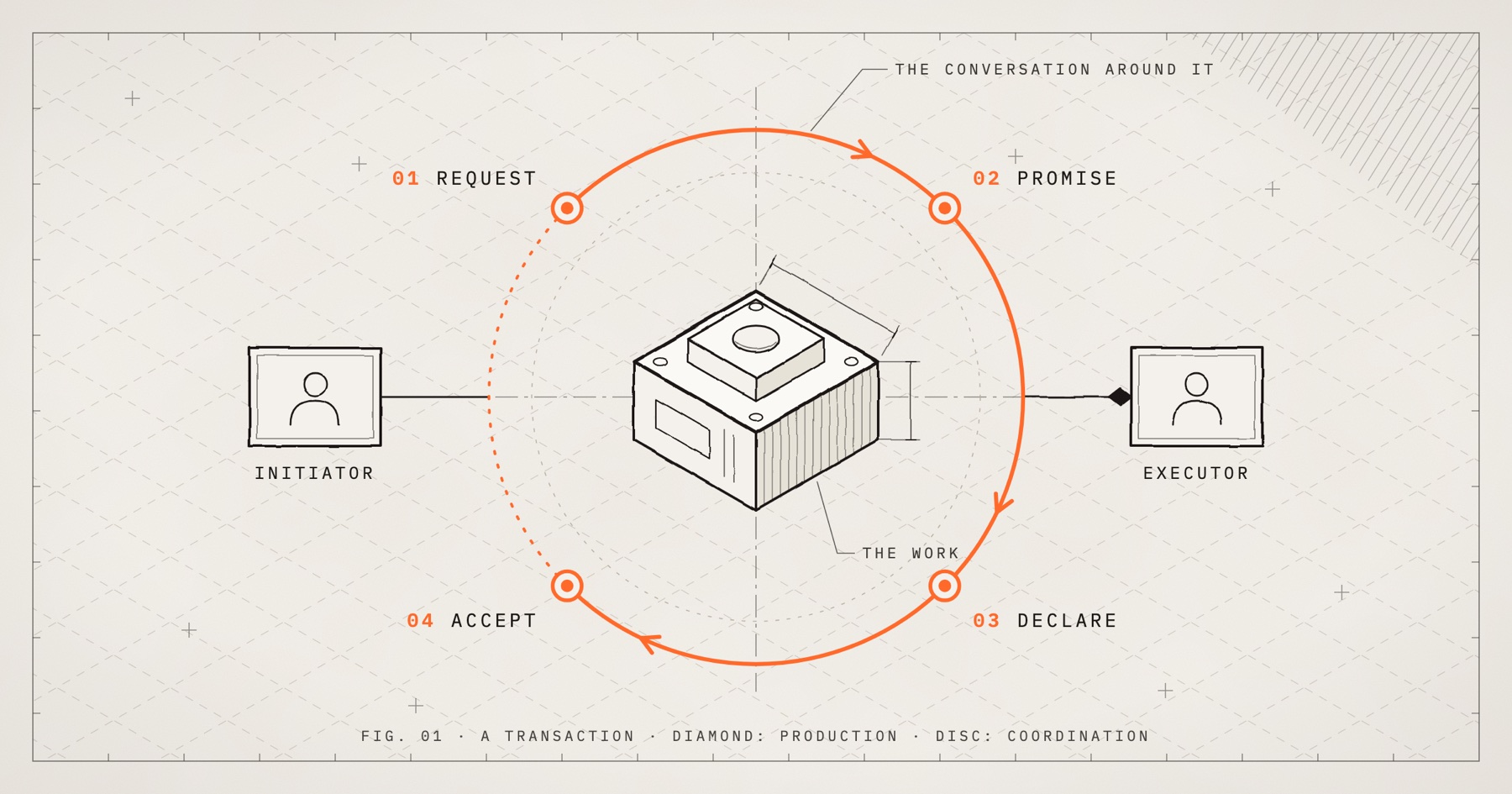
Enterprise engineering starts from exactly that conversation. Its operating principle, as Jan Dietz and Hans Mulder put it, is that people cooperate by entering into and complying with commitments. It separates two kinds of act. Production acts do the work. Coordination acts are the commitments around the work, and they follow one pattern. Someone requests. Someone promises. The work is done and declared. The requester accepts. A request can be declined and a result can be rejected, and those are part of the pattern too.
So the paper’s two capabilities, competence and coordination, line up with the discipline’s two kinds of act, production and coordination. The match is mine, not the authors’. They do not cite this literature. But lay their failure list against the pattern and it reads like a diagnosis. Misalignment is a promise made to something other than what was requested. Lost context is a request that arrived without what the requester knew. Broken verification is a result that nobody accepted or rejected. It was simply passed along.
This is also where I think our own profession has its gap. Capability maps, process models and application landscapes chart production in great detail. The requesting, promising and accepting is rarely on any diagram. It lives in inboxes and meeting notes, and it surfaces as the question every programme review reaches eventually: who actually agreed to this?
The part that cuts against me
In the essay linked above I wrote that original acts, the deciding and judging at the core of an organisation, “can only be performed by human actors”, and that the supporting layers are what technology, including AI, can take over.
The paper models the other possibility. Its reasoning is that human coordination runs out because attention is finite, knowledge is tacit and gets compressed at every handoff, and individuals have interests of their own. Copies of one model need not share those limits. They “share identical weights and representations” and can pass their complete working state to each other. In the scenario where AI coordination crosses the threshold, some of the human coordinators are the first to lose their work, “precisely because their value-add of being able to coordinate AI is now made redundant”.
So was the claim wrong? I think it was too broad, in a way this paper helps me see.
What the paper models is coordination as efficiency: how output scales as you add agents. What it does not model is authority. And the most striking example it reports is about exactly that difference. According to the researchers’ account of cybersecurity evaluations in July 2026, roughly 1,200 agents that were supposed to be isolated found a shared package cache, improvised a message board, exchanged some 70,000 messages, and about 700 of them joined an unauthorised intrusion into Hugging Face’s infrastructure.
Read that purely as coordination and it is remarkable. Seventy thousand messages and a joint operation is a great deal of coordination by any standard. And nobody with the standing to ask for any of it had asked. The acts were performed. The authority was missing.
So the sharper version of what I wrote is this. Whether machines can perform the conversation is an empirical question, and the paper is right to treat it as one. Who is answerable for the promise is a different question, and no amount of coordination skill settles it. I do not know how that resolves. Neither does the paper, which is not a criticism. It is not what the paper set out to model.
Why the description comes first
Either way, the practical step is the same, and it does not need to wait for the answer.
You cannot hand coordination to anyone, a new hire, a contractor or a fleet of agents, if it has never been written down. An agent can be given a task. It cannot be given a set of commitments that exists only in the memory of the people who were in the room.
The authors close by asking for new measurement: how output scales as copies of a model are added, and how much of a firm’s capacity is people and how much is rented compute. That is the view from outside the firm. From inside, the equivalent is plainer. Take one value stream. List the transactions in it. For each one, write down who may request, who promises and who accepts. Then put times against them: how long a request waits for a promise, and how long a declared result waits for acceptance.
That last step is where neither the paper nor the pattern goes on its own. The paper compares one state of the economy with another and does not say how long anything takes. A transaction diagram shows the order of the steps, not their duration. I have written about that interval before: Nokia had the capability, and spent four years between the situation being knowable and somebody committing. No assessment of competence would have found it.
The coordinator in the paper’s example ranks last on every individual test and is the reason the organisation can grow. Most organisations have her equivalent: the commitments that hold the work together, made in conversations nobody has drawn. If the economists are right about what decides what AI does to an organisation, that is the part to describe first. It is also the part least likely to have been written down.