I learned strategy in a room I did not know was a classroom.
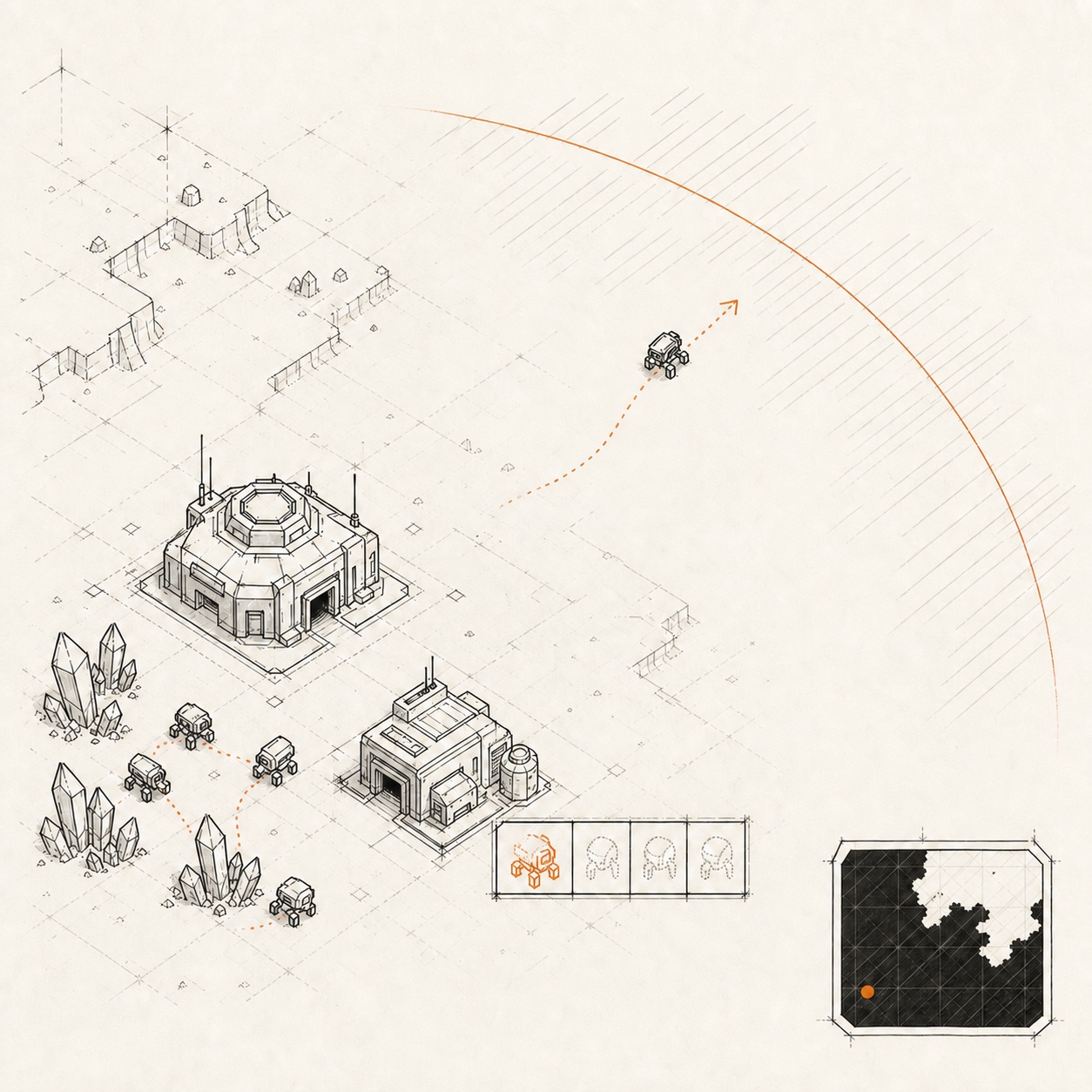
In StarCraft, the fight is decided before it starts if you get one thing wrong. The counter must be in production before the attack lands. You do not build the answer to the army that is hitting you. By then it is over. You build the answer to the army you scouted two minutes ago, on a guess, because units take time to make, and the window between seeing and needing is fixed and closing.
Nobody told me that was a lesson. It was just how you avoided losing.
The game charged for everything, and looking back, the prices were the curriculum. Information was not free. Scouting meant sending a worker that should have been mining, or risking an army timing, and if you chose not to pay, you played blind and deserved what came. Capacity was not free either. You could sit on a pile of resources and still be unable to spend them, because you had forgotten to build the thing that converts wealth into action. The game had a name for that and every player dreaded it. And when you lost, the game handed you the recording. You watched your own defeat with timestamps, because it was one against one and there was no one else to blame. The whole system shipped with an honest ledger.
I want to be careful with the claim here, because it is easy to overstate. I cannot prove the games built any of this in me, and I cannot prove they did not. Maybe a certain kind of teenager chooses a certain kind of game, and the game returns the favour. Formation mostly works as a loop, and nobody runs the control group on their own childhood. So this is not science. It is a map of shared structure, drawn late. What I can trace, move by move, is that the things the game charged for are the things I now measure for a living.
The second room had marks and a lecturer.
In my honours year in Strategic Management, 2004 to 2006, we played the Business Strategy Game. Teams around the world running shoe companies, period by period, against each other. My team came first in our class, and that earned us a playoff against the MBA teams, where we took second. I remember enjoying it in a way the case studies never touched. The cases were photographs. The simulation moved.
Then the professor did something that mattered more than the result. For the next two years he asked me to tutor the teams that were about to fail, the ones whose companies were heading for bankruptcy. I did not think much of it at the time. I think a great deal of it now, for two reasons.
The first is what the assignment actually was. A team facing bankruptcy in a period-based simulation is an organisation running out of time. A fixed number of decision rounds left, competitors compounding, every period spent recovering instead of advancing. Without knowing it, my first consulting engagements were rescue diagnostics on enterprises with closing windows.
The second is what tutoring forces. You cannot tutor intuition. To pull a sinking team back, I had to turn whatever I was doing by feel into named moves that a stressed group of students could execute under pressure. Winning had proved something to the professor. Explaining proved something to me.
Then came the long room, the one that lasted fifteen years.
Somewhere in that period I decided simulation was my thing, and I went looking for the professional version of it. I found system dynamics and spent years playing with Vensim, building stocks and flows, watching loops behave. The tool was wonderful. And I could never find the organisation that needed it. Not once did the moment arrive where a company said yes, build us the model, we will run our decisions through it.
For a long time I read that as my failure to sell it, or the market’s failure to see it. I now think neither was true. The socket did not exist. A simulation model in that era was an expert artifact: every insight had to pass through the modeller, the data had to be gathered by hand, and the model took longer to build and calibrate than the decision it was meant to inform. Executives were being asked to trust simulated numbers against their audited ones, and they declined, reasonably. The models informed thinking in a workshop and then sat on a shelf while the enterprise ran on its systems of record. The field produced fifty years of admiration and very little adoption. I was not wrong about the tool. I was early about the socket.
While I was waiting, the room I started in was quietly demolished.
The market took the game that trained us and split it into thirds. The first cut came from inside the house: the genre that conquered the world began as a fan-made map, built in the old game’s own editor. Defense of the Ancients, made inside Warcraft III. One hero per player, fixed lanes, and everything that was homework stripped out: the economy, the scouting, the build orders. Its descendants, League of Legends and Dota 2, are played by hundreds of millions now. The economy became its own genre too, beloved factory and city builders, Factorio and its kin, where nobody attacks you while you optimise. And the pure decision game boomed as chess, turn-based, perfect information, no economy at all. Every fragment thrived. The bundle disappeared. What no one sells at scale anymore is the combination: an economy, an adversary, imperfect information, and a running clock, all mandatory in one place.
I want to be fair to the fragments, because the strategy did not vanish from them. At the top of the team-fight genre the long game is deep, and the players even call it macro. But it moved from the entry fee to the elective. In 1998 you could not finish a single game without running an economy under fog. Today you can play a thousand happy hours without making one economic decision. The training did not disappear. It stopped being mandatory, and mandatory was the point.
The demolition was never a verdict on depth, either. When DeepMind went looking for the hardest strategy environment on earth for AlphaStar, it did not pick chess, and it did not pick the team fight. It picked StarCraft II, the dying genre, fog and economy and clock and all.
That combination has a name outside gaming. It is called operating an enterprise.
I do not think the fragmenting was anyone’s fault. Engagement sells better than homework, and markets follow. Enterprises did their own version of the same unbundling over the same twenty years: they kept the dashboards, the alerts, and the war-room adrenaline, and quietly dropped the scouting investment, the capacity building, the review of their own defeats. Even the honest ledger went the same way in both worlds. Five players a side means four other people to blame, and the replay habit quietly became the blame habit; a matrixed organisation runs the same arithmetic with more people, and nobody watches the recording of a defeat that belongs to everyone. Both worlds kept the half that fires and lost the half that taught. Nobody is the villain in either story. That is what makes it worth telling.
And then the socket finally arrived.
What changed was not that simulation got easier, although it did. What changed is that enterprises started writing their own timestamps. Every signal, decision, and delivery now leaves a trace in a system of record, which means the thing I once had to model by hand can simply be read: when the signal became available, when someone noticed, when a response was committed, when it landed. The old way ran model first, build the simulation and hope reality sits for its portrait. The way that works runs measurement first, read the actual clock from the actual systems, and let the model earn its way in as the explanation of numbers everyone already accepts.
That is what I build now. I call the thing I measure signal-response distance: how long the whole system takes, from a signal in the world to a response you can observe, held against the window the strategy assumed. It is the fight I learned at a keyboard, the rescue I learned in a tutoring room, and the model I carried through the wilderness, finally plugged into the wall.
The professor saw something in 2005 and pointed. It took me twenty years and an instrument to finish the pointing.
Which leaves the question I cannot put down, and it is not about me. My generation got its reps in a training ground we did not know was one, and that training ground no longer sits at the centre of the culture. The fragments that replaced it are each excellent and each incomplete. Business schools still teach photographs. So where does the next generation of strategists get ten thousand hours of deciding under a closing window, with an economy to run and the fog still on the map?
I do not have a full answer. Building small versions of that room is part of why I do what I do. But I suspect the first step is the one this essay is trying to take: noticing that the room existed, and that it mattered, before we forget there was ever a room at all.